Work performed on ladders, towers, silos, industrial structures, and elevated platforms carries serious safety risks. One missed step, slippery surface, damaged rung, or sudden loss of balance may result in severe injury. A properly designed Vertical Lifeline in Indonesia gives workers continuous fall protection while they climb upward or downward across fixed access routes.
GROXX GEARS supplies heavy-duty industrial equipment developed for demanding construction, maintenance, manufacturing, and facility operations. Its fall arrest solutions support safer movement across elevated structures where standard ladders alone cannot provide enough protection. Each Vertical Lifeline in Indonesia must match the structure, work activity, user capacity, surrounding conditions, and emergency response plan.
Choosing a vertical fall protection system requires more than purchasing a cable and attaching it to a ladder. Proper planning covers anchorage strength, fall clearance, compatible equipment, installation quality, inspections, training, and rescue preparation. These factors help create a dependable system that supports both worker safety and daily productivity.
What Is a Vertical Lifeline System?
A vertical lifeline is a fall arrest system designed to protect workers while climbing or descending a fixed route. The system commonly uses a steel cable, synthetic rope, or rigid rail installed beside or along a ladder. A guided fall arrester connects the worker’s full-body harness to the lifeline.
During normal climbing, the guided device travels with the worker. It allows smooth upward and downward movement without requiring repeated disconnection. Should the worker fall suddenly, the device locks onto the lifeline and helps stop the downward movement.
A complete Vertical Lifeline in Indonesia may include structural anchors, top and bottom brackets, cable tensioners, intermediate supports, guided fall arresters, connectors, energy-absorbing components, and identification labels. Every component must be compatible with the rest of the system.
Permanent systems are often installed on frequently accessed ladders, towers, tanks, and industrial structures. Temporary rope-based systems may suit short-term projects or access routes used only during specific maintenance work. The correct setup depends on the site, climbing frequency, environmental exposure, and work requirements.
Why Vertical Fall Protection Matters Across Indonesian Worksites
Construction, telecommunications, manufacturing, energy, logistics, and building maintenance often require workers to climb elevated structures. Fixed ladders may provide access, but they do not automatically protect a worker from falling. A Vertical Lifeline in Indonesia helps address this gap by keeping the climber connected throughout the access route.
Workers may lose their grip because of wet ladder rungs, dust, oil, fatigue, strong wind, awkward tools, or damaged footwear. High temperatures and long climbing distances may also affect concentration and physical control. Even an experienced worker can experience an unexpected slip.
Continuous connection reduces the need to stop and transfer between separate anchor points. This supports smoother movement while lowering the chance of incorrect reconnection. Workers can keep both hands focused on climbing rather than handling multiple hooks at each section.
A well-planned Vertical Lifeline in Indonesia also supports formal work-at-height procedures. Safety managers can assign approved access routes, establish inspection schedules, control user capacity, and train workers around one defined system. Clear procedures improve consistency across teams and contractors.
Common Applications for a Vertical Lifeline in Indonesia
A Vertical Lifeline in Indonesia can support many industries and elevated access requirements. The system should always be selected according to the specific structure and activity.
Fixed ladders on warehouses, factories, commercial buildings, silos, storage tanks, and industrial machinery are common installation areas. These ladders may lead to roofs, mechanical platforms, service areas, or inspection points. A permanent lifeline allows authorized personnel to climb with continuous protection.
Telecommunications towers also require dependable climbing systems. Technicians may need to install antennas, repair cables, inspect equipment, or replace communication components. Tower height, wind exposure, ladder layout, and rescue access must be considered during system planning.
Industrial facilities use vertical lifelines for access to exhaust stacks, processing vessels, pipe racks, cranes, elevated machinery, and maintenance platforms. Harsh conditions may expose components to chemicals, heat, dust, vibration, or moisture. Materials must suit those conditions.
High-rise properties may require protected routes toward rooftops, facade equipment, mechanical rooms, and building maintenance systems. A Vertical Lifeline in Indonesia can work as part of a broader fall protection plan that includes horizontal lifelines, anchor points, guardrails, suspended access equipment, and rescue systems.
Energy and utility sites may install vertical systems on transmission structures, wind turbines, utility towers, and service ladders. Such locations often involve long climbing distances and limited rescue access, making careful planning especially important.
Main Components of a Vertical Lifeline System
The safety performance of a Vertical Lifeline in Indonesia depends on every component working as one complete system. Mixing unapproved components may affect locking action, clearance, strength, or connection security.
The structural anchorage connects the lifeline to the supporting ladder, tower, wall, or framework. It must be capable of carrying forces created during a fall. A structural review may be required before installation, especially on older, corroded, or modified structures.
The vertical cable, rope, or rail forms the path followed by the guided fall arrester. Stainless steel cable is common for permanent outdoor applications because it offers strength and corrosion resistance. Synthetic rope may suit temporary work, while rigid rail systems may serve high-use access routes.
The guided fall arrester moves along the lifeline during normal climbing. Sudden downward acceleration activates its locking action. Workers must use the exact device approved for the installed cable or rail.
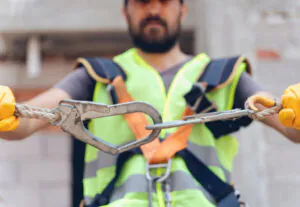
A full-body safety harness distributes arrest forces across stronger areas of the body. Correct fit is essential. Loose straps, incorrect attachment points, twisted webbing, or incompatible connectors may reduce protection.
Additional parts may include carabiners, hooks, brackets, cable tensioners, energy absorbers, end stops, intermediate supports, and entry devices. Labels should show user limits, system details, inspection status, and approved equipment.
Cable-Based and Rail-Based Vertical Lifeline Systems
Cable and rail systems can both provide effective fall protection, but each offers different advantages.
A cable-based Vertical Lifeline in Indonesia offers flexibility across many ladder and tower configurations. Stainless steel cable can cover long climbing distances with support brackets placed at planned intervals. Correct tension helps the guided device move properly and controls unwanted cable movement.
Cable systems may suit towers, silos, industrial ladders, warehouses, and building access routes. They require regular checks for broken strands, corrosion, loose fittings, damaged brackets, and incorrect tension.
Rail-based systems use a rigid track attached to the ladder or structure. The guided device travels directly along the rail. This configuration can reduce cable sway caused by wind, vibration, or movement.
Rigid rails may suit access points used frequently by maintenance teams. They can also provide controlled travel across structures where cable movement would be undesirable. Installation may require more sections, alignment work, and mounting points.
Choosing between cable and rail requires a review of structure type, climbing distance, expected users, access frequency, weather exposure, maintenance capability, and rescue requirements. Price should not be the only deciding factor.
Key Benefits of Installing a Vertical Lifeline in Indonesia
Continuous connection is one of the main advantages of a Vertical Lifeline in Indonesia. Workers can remain attached while moving across the climbing route rather than transferring between separate anchor points.
The system supports hands-free climbing when paired with a compatible guided device and harness. Both hands remain available for maintaining secure contact with the ladder. This may improve climbing control, especially across long access routes.
Permanent systems also remain ready for routine inspections, cleaning, repairs, and maintenance tasks. Workers do not need to set up a temporary lifeline before every climb, provided the permanent system has passed all required checks.
A designated protected route helps control access. Safety teams can limit climbing to trained personnel, verify harness compatibility, and maintain clear records for inspections and repairs.
Worker confidence may also improve when the equipment is properly installed, clearly labeled, and regularly maintained. Confidence should never replace caution, but dependable equipment allows workers to focus on correct movement and assigned tasks.
Engineering Considerations Before Installation
A Vertical Lifeline in Indonesia must be planned around the actual worksite. Generic installation choices may overlook structural weaknesses, insufficient clearance, obstructions, or unsuitable exit points.
Structural strength should be reviewed before mounting anchors and brackets. The ladder or support frame must handle expected loads. Signs of corrosion, cracking, loose fasteners, deformation, or previous damage require attention before installation begins.
Fall clearance must also be calculated. Enough space must remain below the worker so the system can arrest a fall before contact with a lower platform, structure, or ground. Calculations may account for cable movement, harness stretch, energy absorber deployment, connector length, and worker position.
The climbing route should be measured from the entry level to the final safe platform. Rest platforms, ladder transitions, cages, openings, overhangs, and nearby equipment should be documented.
User capacity must be defined. Some systems support only one worker, while others may allow several climbers with required spacing. System ratings and manufacturer instructions determine permitted use.
Weather and industrial exposure also affect material selection. Coastal air, rain, high humidity, chemicals, dust, heat, and vibration can shorten equipment life when unsuitable materials are chosen.
Installation of a Vertical Lifeline System
Installation should begin with a site survey and hazard assessment. Measurements, structural details, access requirements, worker movement, and rescue options should be reviewed before finalizing the layout.
Approved anchorage locations must be confirmed before drilling, welding, bolting, or attaching brackets. Installers should follow manufacturer instructions for spacing, torque, alignment, tension, and component orientation.
Cable or rail sections must provide smooth movement throughout the full route. Guided devices should pass through intermediate supports and transitions without improper resistance. Entry and exit points should allow safe connection before climbing begins and safe disconnection after reaching a protected area.
After installation, the Vertical Lifeline in Indonesia should undergo required checks before being placed into service. System records should include installation dates, equipment models, serial numbers, rated users, inspection requirements, and installer information.
Visible labels should help workers identify system limits and approved devices. Missing or unreadable labels should be replaced because workers need accurate information before use.
Inspection and Maintenance Requirements
Pre-use checks are required before every climb. Workers should inspect their harness, connectors, guided device, visible anchors, cable or rail, brackets, labels, and access route. Any unusual condition should be reported.
Damaged, corroded, loose, or missing parts require immediate attention. Workers should not continue climbing when system status is uncertain.
A competent person should perform scheduled inspections according to manufacturer guidance, site conditions, usage frequency, and applicable safety requirements. Inspection results should be recorded along with repair actions and equipment status.
Any Vertical Lifeline in Indonesia involved during a fall must be removed from service. A qualified person should assess anchors, cables, rails, brackets, energy absorbers, connectors, and supporting structures before reuse.
Cleaning also affects performance. Dirt, grease, paint, chemicals, and debris may interfere with the guided device. Only approved cleaning methods and replacement components should be used.
Worker Training for Vertical Lifeline Use
Workers need practical training before using a Vertical Lifeline in Indonesia. Owning certified equipment does not guarantee safety when users lack correct knowledge.
Training should cover harness fitting, attachment points, connector use, guided device orientation, ladder climbing methods, and system entry procedures. Workers should know how to identify damage and when to stop work.
User limits must be clearly explained. Climbing with an unapproved device, carrying excessive loads, bypassing brackets, or modifying components can create serious hazards.
Emergency procedures also belong within training. Workers should know how to report a fall, contact rescue personnel, protect the area, and avoid making unsafe rescue attempts.
Refresher training may be needed after system changes, long periods without use, observed errors, new equipment introduction, or updates to work procedures.
Common Mistakes to Avoid
Using an incompatible guided fall arrester is a serious mistake. Devices are designed for specific cable diameters, rail profiles, and travel directions.
Skipping inspections can allow hidden damage to remain unnoticed. Corrosion, broken cable strands, loose fasteners, worn connectors, or damaged harness webbing may affect system performance.
Exceeding the approved number of users can place forces beyond the intended system rating. Worker spacing and capacity limits must always be followed.
Unapproved modifications should never be made. Drilling components, replacing parts with general hardware, changing cable tension without guidance, or moving brackets may affect safety.
Rescue planning should not be ignored. A system may stop a fall, but a suspended worker may still need rapid help. Rescue equipment, trained personnel, communication methods, and access plans should be prepared before work begins.
Why Choose GROXX GEARS for a Vertical Lifeline in Indonesia?
GROXX GEARS provides heavy-duty industrial solutions for construction, maintenance, building access, rigging, fastening, and fall protection needs. The company focuses on equipment created for demanding environments where reliability carries major importance.
Its fall arrest solutions include horizontal and vertical lifeline systems that support safer worker movement across roofs, ladders, towers, and elevated structures. Building maintenance systems also support facade cleaning, glass replacement, inspection, and exterior servicing tasks.
GROXX GEARS places strong attention on material strength, accurate manufacturing, controlled tolerances, and long-term performance. These qualities matter when selecting a Vertical Lifeline in Indonesia for regular industrial or commercial use.
Project owners can benefit from solutions selected around structure type, access route, working conditions, and user requirements. A site-focused approach helps avoid poorly matched equipment and supports safer installation planning.
Frequently Asked Questions About Vertical Lifeline in Indonesia
What does a vertical lifeline do?
A vertical lifeline keeps a worker connected to a fall arrest path while climbing or descending. The guided device moves during normal travel and locks after sudden downward movement.
Where can a Vertical Lifeline in Indonesia be installed?
Possible locations include fixed ladders, towers, tanks, silos, warehouses, factories, utility structures, high-rise buildings, industrial plants, and maintenance access routes.
Can several workers use one vertical lifeline?
Some systems may support several users, while others are rated for one person only. Capacity depends on system design, component ratings, anchorage strength, and required worker spacing.
What harness is needed?
A compatible full-body safety harness is normally required. The correct attachment point and connector must match the system instructions.
How often should the system be inspected?
Workers should complete checks before each use. Formal inspections should also be completed by a competent person according to manufacturer requirements and site conditions.
Can the system be reused after stopping a fall?
The system should be removed from service after a fall. A qualified assessment must be completed before any component returns to use.
Is a cable system better than a rail system?
Neither option is automatically better for every site. Structure type, access frequency, climbing distance, weather, vibration, maintenance, user count, and budget all affect the decision.
Does a vertical lifeline replace rescue planning?
No. Fall arrest and rescue serve different purposes. The lifeline stops the fall, while the rescue plan provides a safe method for recovering the suspended worker.
Why select GROXX GEARS?
GROXX GEARS offers industrial equipment and fall protection solutions developed for demanding work areas. Its focus on durable materials, precise manufacturing, system compatibility, and practical site requirements makes it a strong provider for Vertical Lifeline in Indonesia projects.