
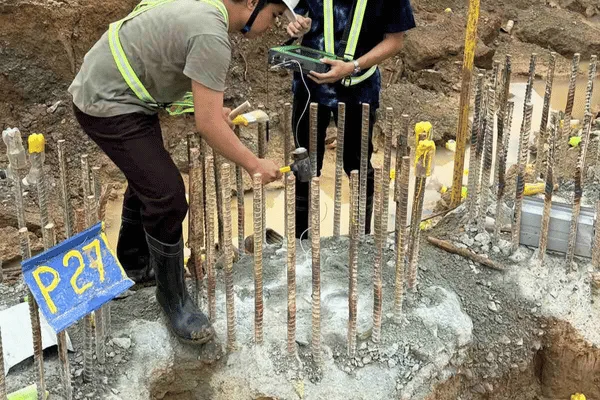
Grout plays an important role across many construction applications. It may fill gaps beneath base plates, secure anchor systems, connect structural components, support equipment foundations, or contribute to the performance of specialized construction assemblies. Because grout can serve a structural purpose, its quality should be verified through suitable testing procedures.
Grout integrity testing Philippines services help construction teams obtain reliable information about grout quality and performance. Proper testing can support quality control, project documentation, engineering evaluation, and compliance with specified requirements.
For contractors, developers, engineers, and quality control teams, selecting an experienced materials testing laboratory can make the testing process more organized and dependable. Inch-On Materials Testing Laboratory provides independent construction materials testing and field testing services, with its laboratory accredited by the Department of Public Works and Highways – Bureau of Research and Standards (DPWH-BRS).
What Is Grout Integrity Testing?
Grout integrity testing refers to the evaluation of grout quality, condition, or specified performance characteristics through appropriate testing procedures. The exact procedure depends on the grout type, intended application, structural requirement, project specification, and applicable testing standard.
A grout integrity testing Philippines program may involve laboratory evaluation, field sampling, specimen preparation, curing, strength testing, or other suitable assessment methods.
Testing can provide measurable information that visual inspection alone cannot provide. A grout surface may appear acceptable while its actual strength or other specified properties require further verification.
For this reason, construction teams should establish testing requirements before grout placement whenever possible. Project plans and specifications can identify the required properties, sampling frequency, acceptance criteria, and applicable standards.
Why Grout Integrity Testing Matters for Philippine Construction Projects
Construction projects depend on materials performing according to their specified requirements. Grout is no exception.
A properly planned grout integrity testing Philippines program can help identify material or workmanship concerns before they become more difficult or expensive to address.
Structural Quality Control
Testing provides measurable data that engineers and quality control teams can compare with project requirements. Results can become part of the project’s quality documentation and help support decisions regarding material acceptance.
Construction Safety
Grout may be used around structural supports, foundations, equipment bases, anchors, and other important components. Verifying specified properties can provide useful technical information for engineers responsible for structural evaluation.
Project Documentation
Laboratory reports can provide records of test specimens, test procedures, measured results, and other relevant information. Such documentation can support inspections, quality-control programs, and project records.
Early Identification of Material Problems
Testing can help identify results that do not meet specified requirements. Early identification gives the project team an opportunity to investigate potential causes and determine an appropriate engineering response.
Common Applications Where Grout Integrity Matters
Grout is used across different construction activities, so the appropriate testing approach should match its application.
Potential applications include:
- Foundation grouting
- Base plate grouting
- Anchor bolt grouting
- Equipment foundation grouting
- Structural connection grouting
- Precast concrete connections
- Masonry-related applications
- Repair and strengthening work
- Specialized foundation applications
A grout integrity testing Philippines program should always consider the actual purpose of the grout. A grout product used beneath heavy equipment may have different testing requirements from grout used for another construction application.
Project engineers should therefore identify the required properties and testing procedures based on design documents, material specifications, and applicable standards.
How Grout Integrity Testing Is Performed
A reliable testing program begins with proper planning. The process can vary according to the selected test method, but several general steps commonly apply.
Step 1: Review Project Requirements
The laboratory and project team should review:
- Construction drawings
- Technical specifications
- Grout product information
- Required strength or performance
- Sampling requirements
- Curing requirements
- Applicable testing standards
- Acceptance criteria
This review helps determine which tests are appropriate.
Step 2: Collect Representative Samples
Representative sampling is essential because laboratory results are only useful when the specimen accurately represents the material being evaluated.
Sampling procedures should follow the applicable project requirements or recognized testing procedure. Batch information, location, date, time, and other relevant details should also be recorded.
Step 3: Prepare Test Specimens
Depending on the selected test, grout specimens may require controlled preparation and curing.
Proper specimen identification is important throughout the process. Each specimen should remain traceable to its source and project location.
Step 4: Conduct Laboratory Testing
The selected test is performed using suitable laboratory equipment and procedures.
For strength-related testing, the laboratory evaluates the specimen under controlled conditions. Other grout tests may examine different physical or performance characteristics.
Step 5: Evaluate the Results
Measured results are compared with the requirements established by the project documents or applicable testing standard.
A result that does not meet the specified requirement may require additional investigation by the responsible engineer or project team.
Step 6: Prepare the Technical Report
A testing report can document relevant information such as:
- Project identification
- Sample identification
- Sampling location
- Test method
- Specimen information
- Test date
- Measured results
- Applicable requirements
- Relevant observations
Clear reporting allows engineers and construction teams to review the results efficiently.
What Properties Can Grout Testing Evaluate?
The properties evaluated depend on the grout formulation, application, and selected testing procedure.
Possible areas of evaluation include:
Compressive Strength
Compressive strength testing can provide information about the ability of cured grout specimens to withstand compressive loading.
This information may be important for grout used within structural applications where a specified strength requirement has been established.
Flow and Consistency
Fresh grout workability can affect placement. Appropriate flow or consistency testing may help determine whether the material has characteristics suitable for its intended use.
Density
Density measurements can provide useful information regarding material characteristics and quality control, depending on the grout specification.
Expansion or Shrinkage Characteristics
Certain grout applications may have requirements related to dimensional stability. Where specified, suitable testing can evaluate these characteristics.
Uniformity and Integrity
Depending on the selected method, testing may provide information related to material uniformity or internal conditions.
It is important to avoid treating every test as a universal measure of grout integrity. The selected procedure should match the property that needs verification.
Grout Integrity Testing Methods and Related Quality Checks
A comprehensive grout integrity testing Philippines program may involve different forms of testing depending on project requirements.
| Testing Area | What It Can Evaluate | Potential Project Purpose |
|---|---|---|
| Compressive strength testing | Strength of cured grout | Strength verification |
| Flow or consistency testing | Fresh grout workability | Placement quality |
| Density testing | Material density | Quality control |
| Expansion-related testing | Dimensional behavior | Specialized grout applications |
| Visual examination | Visible surface condition | Initial inspection |
| Integrity assessment | Internal condition where an appropriate method applies | Investigation of potential defects |
| Sampling and curing control | Specimen reliability | Valid laboratory results |
Each method has a defined purpose. A qualified laboratory can help determine which testing procedure matches the project’s requirements.
ASTM and AASHTO Standards for Construction Materials Testing
Recognized testing standards provide established procedures for evaluating construction materials.
Inch-On Materials Testing Laboratory follows ASTM and AASHTO testing standards as part of its materials testing services. Its stated laboratory scope includes construction materials testing, while its field testing capabilities cover soil, concrete, and foundation piles.
For grout integrity testing Philippines projects, the applicable standard should be selected according to the grout material, intended application, test property, and project specification.
A common mistake is assuming that one ASTM designation automatically applies to every grout product or application. Engineers and testing laboratories should verify the appropriate standard before testing begins.
The Role of a DPWH-BRS Accredited Testing Laboratory
Laboratory accreditation provides an important consideration when selecting a construction materials testing provider.
Inch-On Materials Testing Laboratory is accredited by the Department of Public Works and Highways – Bureau of Research and Standards. The company was established in November 2018 and provides independent testing for soil and construction materials.
Its services cover both laboratory and field testing. Specialized equipment is used for various testing activities, while technical reporting provides project teams with documented test information.
For construction professionals searching for grout integrity testing Philippines, laboratory accreditation can be one factor to consider when evaluating a testing provider.
Why Choose Inch-On Materials Testing Laboratory for Construction Material Testing?
Inch-On Materials Testing Laboratory provides testing services designed to support construction quality, material verification, and structural evaluation.
DPWH-BRS Accreditation
Inch-On holds DPWH-BRS accreditation, supporting its role as an independent engineering and construction laboratory.
ASTM and AASHTO Testing Standards
The laboratory follows ASTM and AASHTO testing standards for applicable testing services. Standardized procedures help provide consistent methods for evaluating construction materials.
Laboratory and Field Testing Capabilities
Inch-On provides laboratory testing for construction materials along with field testing services. Its field-testing portfolio includes soil, concrete, and foundation pile testing.
This combination can be useful for projects requiring multiple forms of technical verification.
Specialized Testing Equipment
Construction materials testing requires suitable equipment, proper procedures, and trained personnel. Inch-On uses specialized equipment for its laboratory and field testing activities.
Technical Reports
Clear reports help construction professionals understand test results and maintain project quality records. Documentation can also support engineering review and project inspection activities.
Grout Integrity Testing vs. Visual Inspection
Visual inspection has value, but it cannot provide every type of information needed for material verification.
| Visual Inspection | Grout Integrity Testing |
|---|---|
| Focuses primarily on visible conditions | Uses a defined testing procedure |
| Can identify obvious surface concerns | Can provide measurable technical data |
| Limited ability to evaluate hidden conditions | Method-dependent assessment of specified properties |
| Useful as an initial quality check | Useful for documented material verification |
| Usually quick to perform | May require sampling, laboratory work, or specialized equipment |
These approaches should not necessarily be treated as competing methods. Visual inspection and appropriate testing can serve complementary quality-control purposes.
Common Grout Problems That Testing Can Help Identify
Several factors can affect grout performance. Testing may help identify results associated with material or construction concerns.
Potential issues include:
- Low measured strength
- Improper batching
- Excess water
- Inconsistent mixing
- Poor curing
- Inadequate placement
- Material segregation
- Voids or discontinuities where an appropriate integrity method is available
- Insufficient consolidation
- Nonconformance with project specifications
The presence of a testing result outside the specified range does not automatically identify the exact cause. Additional review may be required to determine whether the issue originated from material selection, batching, placement, curing, sampling, or another factor.
When Should Grout Be Tested?
Testing schedules should follow project specifications and the requirements established by the responsible engineer.
Testing may be considered during several project stages.
Before Major Structural Work Progresses
Testing can provide quality information before subsequent construction activities make investigation more difficult.
During Routine Quality Control
Regular testing can help construction teams maintain documented control over material quality.
After Grout Placement
Depending on the specified test, samples may be evaluated after curing or at another required testing stage.
When Results Appear Questionable
Unexpected results, visible concerns, or inconsistencies between batches may justify additional testing or engineering investigation.
During Project Acceptance
Testing documentation may form part of the quality records required for project review and acceptance.
During Repair or Rehabilitation
Existing structures may require testing when engineers need additional information before repair or strengthening work.
How to Select a Grout Testing Laboratory in the Philippines
Choosing a testing provider requires more than searching for a laboratory that offers construction testing.
Project teams should consider several factors.
Verify Laboratory Accreditation
Check whether the laboratory holds relevant accreditation for its stated services.
Confirm Testing Capabilities
Ask whether the laboratory performs the specific test required by the project.
Review Applicable Standards
Confirm that the proposed procedure matches the grout type, application, and required property.
Ask About Equipment
Testing equipment should be appropriate for the selected procedure and properly maintained or calibrated according to applicable requirements.
Discuss Sampling Procedures
Ask how samples will be collected, identified, transported, prepared, and cured.
Review Reporting Procedures
A useful report should clearly identify the sample, method, results, and relevant project information.
Confirm Project Requirements
Provide the laboratory with drawings, specifications, grout product information, and required acceptance criteria whenever available.
These steps can help make grout integrity testing Philippines projects more organized and technically consistent.
Why Field and Laboratory Testing Work Together
Construction quality does not depend on laboratory testing alone. Site conditions, placement practices, foundation conditions, and existing structural conditions can also affect project performance.
Inch-On Materials Testing Laboratory offers field testing involving soil, concrete, and foundation piles, alongside laboratory testing for soil and construction materials.
Its field testing services include methods such as Field Density Testing, Rebound Hammer Testing, Rebar Scanning, Pile Integrity Testing, Pile Dynamic Testing, Crosshole Sonic Logging, Standard Penetration Testing, and Ultrasonic Testing.
For projects requiring multiple forms of evaluation, coordinated field and laboratory testing can provide broader technical information for project teams.
Preparing for Grout Integrity Testing
Good preparation can help prevent delays and improve sample traceability.
Before arranging grout integrity testing Philippines, prepare the following information where available:
- Project name
- Project location
- Construction drawings
- Technical specifications
- Grout product name
- Manufacturer information
- Batch information
- Required strength
- Required testing method
- Sampling location
- Sampling schedule
- Curing requirements
- Acceptance criteria
- Engineer or inspector requirements
Providing complete project information allows the testing laboratory to better understand the requested service.
Grout Integrity Testing Philippines: Supporting Better Construction Decisions
Quality testing provides information that can support engineering and construction decisions.
For grout applications, the correct testing approach depends on the material and its intended function. A laboratory should not simply apply the same procedure to every grout application.
A well-planned grout integrity testing Philippines program considers the project specification, applicable standard, sampling procedure, specimen preparation, curing conditions, laboratory equipment, test method, and reporting requirements.
When combined with appropriate field testing and engineering evaluation, laboratory data can become a valuable component of a project’s quality-control system.
For construction teams, the goal is not simply to obtain a test report. The objective is to obtain reliable technical information that can support responsible decisions about material quality and project performance.
Frequently Asked Questions About Grout Integrity Testing Philippines
What is grout integrity testing?
Grout integrity testing is the evaluation of grout quality, condition, or specified performance characteristics using an appropriate testing procedure. The selected method depends on the grout type, application, project specification, and required property.
Why is grout testing important for construction projects?
Grout may serve structural or support functions within a construction project. Testing can provide measurable information about specified properties and help construction teams maintain quality records.
Where can I request grout integrity testing Philippines services?
Construction professionals can contact Inch-On Materials Testing Laboratory to discuss project-specific testing requirements. The laboratory provides independent construction materials testing and field testing services.
What standards are used for grout testing?
The applicable standard depends on the grout type and property being evaluated. Inch-On follows ASTM and AASHTO testing standards for applicable testing services.
Can grout testing be performed on-site?
Some activities involve field sampling or field assessment, while other tests require laboratory evaluation. The appropriate workflow depends on the selected testing method and project requirements.
How long does grout testing take?
Turnaround time depends on the selected test, specimen preparation, curing period, laboratory workload, and reporting requirements. Project teams should confirm the expected schedule with the testing laboratory before testing begins.
What information should I provide when requesting grout testing?
Provide the project specifications, grout type, intended application, required strength or other performance criteria, sampling details, applicable standards, and any engineer or inspector requirements.
Why should I choose a DPWH-BRS accredited laboratory?
Accreditation provides an important qualification when evaluating a testing laboratory. Inch-On Materials Testing Laboratory is DPWH-BRS accredited and provides laboratory and field testing services for construction-related applications.
Does Inch-On provide other construction testing services?
Yes. Inch-On provides laboratory testing for construction materials and field testing involving soil, concrete, and foundation piles. Its listed services include concrete-related testing, Concrete Hollow Block testing, soil testing, aggregate testing, pile integrity testing, Crosshole Sonic Logging, ultrasonic testing, and other field and laboratory services.
Takeaway
Grout integrity testing Philippines provides construction teams with technical information that can support material quality control, engineering evaluation, project documentation, and construction planning.
The correct testing method should always match the grout application, project specification, required property, and applicable standard. Proper sampling, specimen preparation, curing, laboratory procedures, and reporting are also important parts of a dependable testing program.
For contractors, developers, engineers, and quality control teams, working with an accredited materials testing laboratory can help create a structured approach to construction material verification.
Inch-On Materials Testing Laboratory provides independent laboratory and field testing services, with DPWH-BRS accreditation and testing procedures based on applicable ASTM and AASHTO standards. For projects requiring grout integrity testing Philippines, contacting the laboratory early can help clarify testing requirements and establish an appropriate testing workflow.