
Market Context: Why Modern Sales Training Frameworks Matter in Complex B2B Environments
Modern B2B sales environments have shifted dramatically due to informed buyers, longer evaluation cycles, and increased stakeholder involvement. Buyers today conduct extensive independent research before engaging with sales teams, which reduces the effectiveness of traditional pitch-driven selling. As a result, organizations are forced to adopt more structured and repeatable sales training systems to remain competitive. Revenue teams are also under pressure to improve predictability, especially in enterprise deals where multiple variables influence outcomes. This has elevated the importance of formal methodologies that guide both qualification and discovery conversations. In this environment, frameworks such as MEDDIC and Gap Selling are widely used to standardize performance.
Sales organizations often struggle with inconsistency when individual reps rely solely on intuition or personal style. Structured methodologies help eliminate guesswork and bring discipline to pipeline management. At the same time, companies are looking for ways to increase win rates without overcomplicating their sales process. This creates a tension between structured qualification systems and flexible discovery-based approaches. Understanding how different frameworks solve different parts of this challenge is essential for modern revenue teams.
Key drivers shaping adoption of sales methodologies include:
- Increasing deal complexity across enterprise and mid-market segments
- Greater involvement of procurement and finance teams in decision-making
- Higher expectations for ROI justification and measurable outcomes
- Demand for improved forecasting accuracy from leadership teams
- Need for scalable onboarding and training systems for sales reps
These pressures set the stage for comparing MEDDIC and Gap Selling as two influential approaches in modern sales training programs.
Understanding the MEDDIC Sales Process Framework
MEDDIC is a qualification-focused sales methodology designed to improve forecasting accuracy and pipeline discipline. It is widely used in enterprise environments where deals are complex and involve multiple stakeholders. The framework ensures that sales professionals systematically evaluate whether an opportunity is real, viable, and likely to close. MEDDIC is particularly valuable in environments where losing visibility into deal quality can significantly impact revenue predictability. It emphasizes structured validation rather than assumption-based selling.
Each component of MEDDIC serves a specific purpose in deal qualification and management. Metrics focus on quantifying business value and identifying measurable outcomes that justify investment. The Economic Buyer component ensures that the salesperson identifies the individual with final financial authority. Decision Criteria and Decision Process provide clarity on how organizations evaluate vendors and make purchasing decisions. Identifying Pain ensures that the business issue is significant enough to justify change. The Champion element helps ensure internal advocacy for the solution.
Core elements of MEDDIC in practice
- Metrics tied to ROI, cost savings, or revenue impact
- Economic Buyer identification and engagement strategy
- Defined Decision Criteria across stakeholders
- Clear mapping of Decision Process steps and timelines
- Deep understanding of Pain and business urgency
- Strong internal Champion development
MEDDIC is highly structured, which makes it effective for forecasting and deal inspection. However, it requires consistent discipline from sales teams to be implemented correctly. When executed well, it reduces pipeline noise and increases visibility into deal progression. It is especially effective in large organizations with formal procurement processes and long sales cycles.
Understanding Gap Selling Sales Methodology
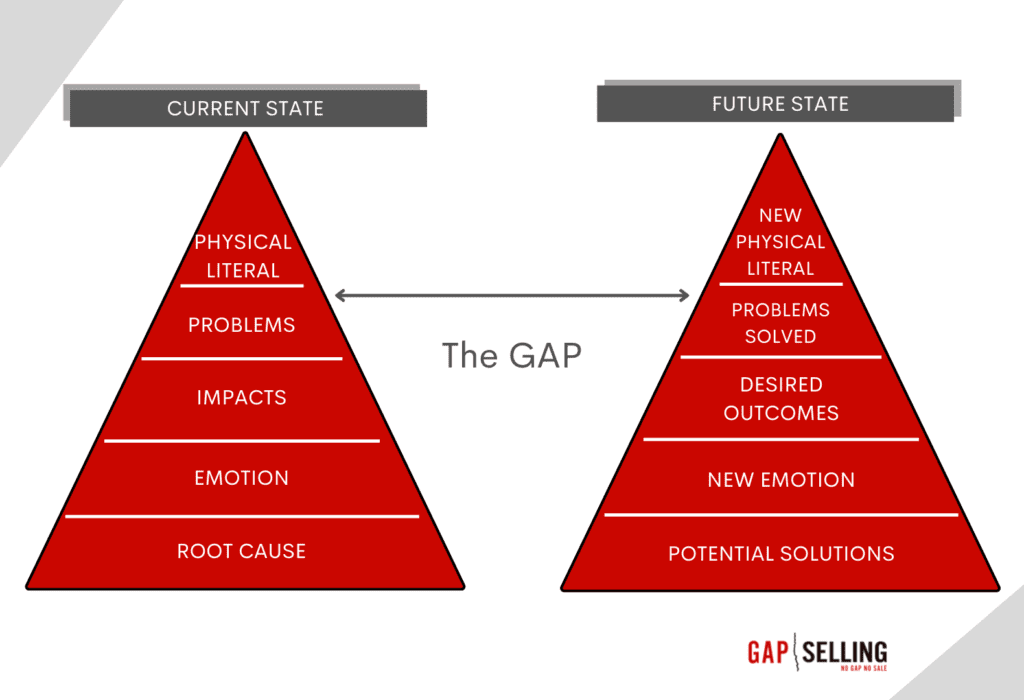
Gap Selling is a discovery-driven methodology focused on identifying the difference between a customer’s current state and their desired future state. Instead of starting with qualification, it prioritizes deep understanding of the customer’s business problems. This approach emphasizes uncovering root causes rather than surface-level symptoms. Sales professionals using Gap Selling aim to build urgency by expanding the perceived cost of inaction. The methodology shifts the conversation from product features to business transformation.
Gap Selling requires strong diagnostic questioning skills and active listening. It is designed to challenge assumptions and uncover hidden inefficiencies within an organization. The goal is not just to sell a solution but to fully articulate the consequences of staying in the current state. This makes it especially powerful in complex or consultative sales environments where customers may not fully understand their problems.
Key components of Gap Selling methodology
- Deep analysis of Current State conditions
- Clear definition of Future State objectives
- Identification of the Gap between both states
- Root cause analysis of business challenges
- Impact evaluation of unresolved issues
- Value articulation tied to business outcomes
Gap Selling is highly effective in creating demand where it may not be fully developed. However, it requires time and skill to execute properly, especially in fast-moving sales environments. Reps must be comfortable engaging in deeper conversations rather than relying on scripted qualification checklists. When used effectively, it significantly improves deal quality and customer alignment.
Philosophical Differences Between MEDDIC and Gap Selling
MEDDIC and Gap Selling differ fundamentally in how they approach the sales process. MEDDIC is structured around validation and qualification, ensuring that deals meet specific criteria before progressing. Gap Selling, on the other hand, is focused on discovery and value creation through problem exploration. One prioritizes control of the pipeline, while the other prioritizes expansion of opportunity value. These differences shape how sales teams engage with customers and manage deals.
MEDDIC is primarily internal-facing in its discipline, helping sales teams evaluate whether to continue investing time in a deal. Gap Selling is external-facing in its approach, helping buyers understand the full extent of their challenges. MEDDIC reduces risk by filtering out weak opportunities early, while Gap Selling increases opportunity size by uncovering deeper problems. Both methodologies influence decision-making but in different directions.
Key philosophical contrasts include:
- Qualification discipline versus discovery depth
- Process validation versus problem expansion
- Internal forecasting focus versus external value creation
- Structured pipeline control versus conversational exploration
- Risk reduction versus opportunity amplification
These differences make each methodology suitable for different stages of sales maturity and organizational goals.
Sales Discovery Approach Comparison
Discovery is where MEDDIC and Gap Selling diverge most clearly in execution. MEDDIC discovery is focused on validating known criteria, confirming stakeholders, and understanding decision processes. Gap Selling discovery is designed to uncover unknown problems and develop insight-driven conversations. The depth and direction of questioning differ significantly between the two approaches.
MEDDIC discovery often includes targeted questions such as identifying the economic buyer, understanding procurement steps, and validating measurable metrics. Gap Selling discovery focuses on asking questions that reveal inefficiencies, missed opportunities, and operational gaps.
Discovery focus areas comparison
- MEDDIC emphasizes stakeholder mapping and decision structure
- Gap Selling emphasizes root cause exploration and impact analysis
- MEDDIC confirms readiness to buy
- Gap Selling creates awareness of need to buy
- MEDDIC reduces uncertainty in pipeline
- Gap Selling increases perceived value of change
Both approaches require strong communication skills, but they serve different strategic purposes in the sales cycle.
Qualification and Deal Progression Differences
MEDDIC is heavily oriented toward qualification, ensuring that sales teams focus only on high-probability opportunities. It helps eliminate deals that lack urgency, budget, or authority alignment. Gap Selling does not prioritize early qualification in the same way, instead focusing on expanding deal value before evaluating viability. This difference significantly impacts how pipelines are managed.
MEDDIC ensures that each opportunity meets specific criteria before advancing to the next stage. Gap Selling allows for deeper exploration before determining whether the opportunity should continue. This can lead to larger deal sizes but may also increase time spent on unqualified opportunities if not managed carefully.
MEDDIC progression is structured and controlled, while Gap Selling progression is more fluid and insight-driven. Organizations often choose between them based on whether their priority is efficiency or expansion.
Forecasting and Revenue Predictability
MEDDIC is widely recognized for improving forecasting accuracy due to its structured qualification framework. Each component of MEDDIC provides a checkpoint that helps validate deal health. This reduces surprises late in the sales cycle and improves leadership confidence in revenue projections. Gap Selling contributes to forecasting indirectly by improving clarity around deal value and urgency. However, it does not inherently enforce strict qualification gates.
Organizations that rely heavily on MEDDIC often experience more stable forecasting outcomes. Gap Selling-driven teams may experience greater variability but also larger upside potential in deal size. The choice between them often depends on how much predictability versus growth is prioritized.
Buyer Alignment and Stakeholder Management
MEDDIC provides a structured approach to identifying and mapping stakeholders within an organization. It ensures that sales teams engage with all relevant decision-makers early in the process. Gap Selling focuses more on aligning stakeholders around shared problems and outcomes. Instead of mapping authority structures, it builds consensus through shared understanding of the business gap.
Both approaches emphasize the importance of internal champions, but they develop them differently. MEDDIC champions help navigate procurement processes, while Gap Selling champions help reinforce the urgency of the problem.
When MEDDIC Sales Process Performs Best
MEDDIC is most effective in environments where deal structure and predictability are critical. It is commonly used in enterprise SaaS, infrastructure, and complex B2B solutions. Organizations with long sales cycles benefit significantly from its structured qualification approach. It is also effective in teams where leadership requires high forecast accuracy. MEDDIC works best when buying processes are formal and heavily regulated.
When Gap Selling Sales Methodology Delivers Strong Results
Gap Selling performs best in environments where customers may not fully understand their problems. It is highly effective in consultative selling and transformation-based solutions. Industries with complex operational inefficiencies benefit significantly from this approach. It is also useful in competitive markets where differentiation depends on insight rather than features. Gap Selling helps create urgency where none previously existed.
Integrating MEDDIC and Gap Selling in a Hybrid Sales Model
Many organizations find value in combining both methodologies to balance structure and discovery. Gap Selling can be used during early discovery to uncover deep customer needs. MEDDIC can then be applied during later stages to validate deal viability and improve forecasting accuracy. This hybrid approach allows teams to maximize both deal quality and pipeline discipline.
Successful integration requires clear stage definitions and consistent coaching. Sales leaders must ensure that reps understand when to switch between discovery and qualification modes. Without proper alignment, teams may struggle with inconsistent execution.
Designing Effective Sales Training Programs
Effective sales training programs must go beyond theory and focus on practical application. Reps should be trained through real deal scenarios and live simulations. MEDDIC training often includes pipeline inspection exercises and deal qualification reviews. Gap Selling training focuses on questioning techniques and discovery conversations.
Training effectiveness improves when reinforced through continuous coaching and CRM integration. Managers play a critical role in ensuring methodology adoption. Without reinforcement, even the best frameworks lose effectiveness over time.
Frequently Asked Questions
What is the main difference between MEDDIC and Gap Selling?
MEDDIC focuses on structured qualification and forecasting, while Gap Selling focuses on uncovering deep customer problems and value gaps.
Can both methodologies be used together?
Yes, many organizations use Gap Selling for discovery and MEDDIC for qualification and forecasting discipline.
Which methodology is better for enterprise sales?
MEDDIC is often preferred for enterprise forecasting accuracy, while Gap Selling is strong for complex discovery conversations.
Is Gap Selling harder to learn than MEDDIC?
Gap Selling can be more challenging due to its emphasis on deep discovery and critical thinking skills.
Does MEDDIC improve win rates?
Yes, MEDDIC improves win rates by filtering weak opportunities and improving deal qualification accuracy.
Takeaway
Sales organizations today operate in environments where both precision and insight are essential for success. MEDDIC provides the structure needed to manage complex pipelines and improve forecasting accuracy. Gap Selling delivers the depth required to uncover meaningful customer problems and create stronger value alignment. When applied together thoughtfully, they can complement each other and elevate overall sales performance. The key is understanding when to prioritize qualification discipline and when to focus on discovery depth.
Read More: https://salesgrowth.com/meddic-vs-gap-selling-sales-training/