Safe and reliable foundations depend on accurate knowledge of subsurface soil conditions before construction begins. The Standard Penetration Test plays a central role in geotechnical engineering by measuring soil resistance and helping engineers understand how the ground will behave under structural loads.
The Standard Penetration Test is widely applied in site investigation programs for residential, commercial, and infrastructure projects. It provides direct field data that supports foundation design, settlement assessment, and soil classification. Without a Standard Penetration Test, construction teams risk working with unknown ground conditions that may lead to uneven settlement or structural instability over time.
A properly conducted Standard Penetration Test helps engineers determine whether the soil is suitable for shallow foundations or if deep foundations are required. It also supports cost-efficient design by preventing unnecessary overdesign or unsafe underdesign.
What is the Standard Penetration Test?
The Standard Penetration Test is a field testing method used in geotechnical soil investigation to measure soil resistance at different depths. It is performed inside a borehole using a split-spoon sampler driven into the soil by a standardized hammer system.
The main purpose of the Standard Penetration Test is to evaluate soil density, strength, and consistency. The resistance encountered during sampling is recorded as the N-value, which represents the number of hammer blows required to drive the sampler into the soil at a specified depth.
Engineers rely on Standard Penetration Test results to estimate bearing capacity, assess settlement risk, and identify changes in soil layers. This makes the Standard Penetration Test one of the most widely accepted methods in geotechnical engineering practice.
Standard Penetration Test Procedure in the Field
The Standard Penetration Test follows a systematic field procedure to ensure consistent and reliable results across different project sites.
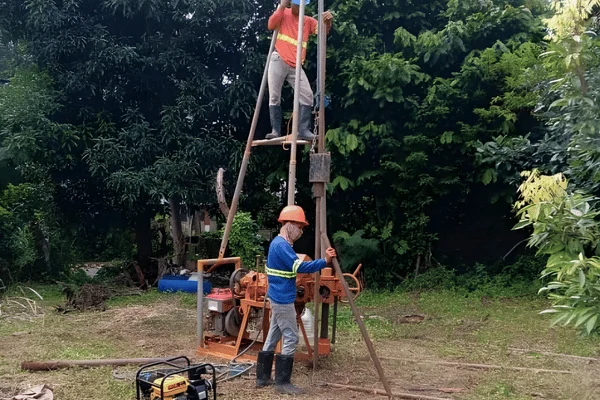
The process begins with borehole drilling to reach the required test depth. Once the borehole is prepared, a split-spoon sampler is lowered into position. A standard hammer with a fixed weight is then dropped from a specific height to drive the sampler into the soil.
The number of hammer blows required to penetrate successive intervals of soil is carefully recorded. The total blow count from the last two intervals is used to calculate the Standard Penetration Test N-value.
After each test interval, soil samples are retrieved for visual classification and laboratory analysis. This combination of field and laboratory work improves the reliability of Standard Penetration Test results and supports detailed geotechnical interpretation.
Equipment Used in Standard Penetration Test
The Standard Penetration Test requires calibrated and standardized equipment to maintain accuracy and consistency.
Key equipment includes a drilling rig used to create boreholes, a split-spoon sampler for soil collection, and a standard hammer system used to deliver controlled impact energy. Drill rods connect the hammer and sampler system to the surface, allowing controlled penetration into deeper soil layers.
Additional tools used in the Standard Penetration Test include casing pipes to stabilize boreholes, depth measurement devices, and recording instruments for blow count documentation. Proper calibration of equipment ensures that Standard Penetration Test results remain consistent across different sites and operators.
Understanding Standard Penetration Test N-Value
The N-value is the most important output of the Standard Penetration Test. It represents the resistance of soil to penetration and reflects its relative strength and density.
Low N-values typically indicate loose or soft soil conditions, while higher N-values indicate dense or stiff soil layers. Engineers use Standard Penetration Test N-values to classify soil types such as loose sand, medium dense sand, stiff clay, or very dense soil.
The Standard Penetration Test N-value also serves as a key input for estimating soil bearing capacity. This helps structural engineers determine whether the soil can safely support proposed loads or if foundation modification is necessary.
Importance of Standard Penetration Test for Foundation Design
The Standard Penetration Test plays a major role in foundation engineering by providing direct field data about soil behavior under load conditions.
One of the main benefits of the Standard Penetration Test is its ability to identify weak soil layers that may not support structural loads. These weak zones often include soft clay deposits or loose sandy layers that can lead to settlement issues if not properly addressed.
The Standard Penetration Test also supports the selection of foundation type. Shallow foundations may be suitable for strong soil layers with high N-values, while deep foundations may be required when weak soils are present at shallow depths.
By providing reliable subsurface data, the Standard Penetration Test reduces uncertainty in structural design and improves long-term safety performance.
Standard Penetration Test in Philippine Construction Conditions
Construction projects in the Philippines face unique geotechnical challenges due to varying soil conditions and seismic activity. The Standard Penetration Test is especially important for evaluating these complex ground conditions.
Soil profiles can change significantly within short distances, making field-based testing essential for accurate assessment. The Standard Penetration Test helps engineers identify these variations and adjust foundation designs accordingly.
Seismic considerations also increase the importance of the Standard Penetration Test. Soil density and stiffness directly affect how ground motion behaves during earthquakes. Accurate Standard Penetration Test data helps engineers design structures that can better withstand seismic forces.
Standards and Compliance in Standard Penetration Test
The Standard Penetration Test follows internationally recognized testing standards to ensure reliability and consistency.
Most Standard Penetration Test procedures align with ASTM and AASHTO guidelines, which define equipment specifications, testing methods, and result interpretation. These standards ensure that results remain consistent across different laboratories and project sites.
Local regulatory requirements from DPWH-BRS also recognize the importance of Standard Penetration Test data for construction approval and safety compliance. Many building projects require soil investigation reports that include Standard Penetration Test results before permits are issued.
Applications of Standard Penetration Test
The Standard Penetration Test is widely used across different types of construction and infrastructure projects.
It is commonly applied in building foundation design for residential and commercial structures. The Standard Penetration Test is also essential for road and highway construction, where soil stability affects pavement performance.
Bridge foundations rely heavily on Standard Penetration Test data to ensure load-bearing capacity at deeper soil levels. Retaining walls and slope stability projects also depend on Standard Penetration Test results to evaluate soil resistance and reduce failure risks.
Because of its versatility, the Standard Penetration Test remains a core method in geotechnical site investigation programs.
Advantages of Standard Penetration Test
The Standard Penetration Test offers several important advantages for geotechnical engineering work.
It is a practical field method that provides direct measurement of soil resistance at various depths. The Standard Penetration Test is also cost-effective compared to more complex testing methods, making it suitable for a wide range of projects.
Another advantage of the Standard Penetration Test is its wide acceptance in engineering practice. Many design codes and guidelines reference Standard Penetration Test results for foundation design and soil classification.
The Standard Penetration Test also provides data that can be correlated with other soil properties, improving overall interpretation of site conditions.
Limitations of Standard Penetration Test
While the Standard Penetration Test is widely used, it also has limitations that must be considered during interpretation.
Results from the Standard Penetration Test can be influenced by operator technique and equipment condition. Variations in hammer energy transfer may affect N-value accuracy.
The Standard Penetration Test also provides limited information in very soft or very dense soils, where penetration behavior may not fully reflect true soil strength.
For this reason, Standard Penetration Test results are often combined with laboratory testing and other field methods to improve reliability in geotechnical analysis.
Integration of Standard Penetration Test with Laboratory Testing
A complete geotechnical investigation combines the Standard Penetration Test with laboratory soil testing.
Field data from the Standard Penetration Test provides real-world soil resistance values, while laboratory testing identifies soil classification, moisture content, and plasticity characteristics.
When combined, Standard Penetration Test results and laboratory analysis produce a more complete understanding of subsurface conditions. This integrated approach improves foundation design accuracy and construction safety.
Why Choose Inch-On Materials Testing Laboratory
Inch-On Materials Testing Laboratory is a DPWH-BRS accredited engineering and construction testing facility established in November 2018. The laboratory provides field and laboratory services for soil, concrete, and pile foundation evaluation.
The company conducts Standard Penetration Test services using calibrated equipment and follows ASTM and AASHTO standards for accuracy and reliability. Field investigations are supported by laboratory analysis to deliver complete geotechnical reports for construction projects.
Through Standard Penetration Test programs and other geotechnical services, Inch-On Materials Testing Laboratory supports engineers, contractors, and project owners in making informed decisions for safe and stable foundation design.
Takeaway
The Standard Penetration Test remains a key method in geotechnical engineering for evaluating soil strength and guiding foundation design decisions. Its ability to provide direct field data makes it essential for safe and efficient construction planning.
By combining Standard Penetration Test results with laboratory analysis and professional engineering interpretation, construction projects achieve greater reliability and long-term stability across varying soil conditions.
Frequently Asked Questions About Standard Penetration Test
What is the Standard Penetration Test used for?
The Standard Penetration Test is used to measure soil resistance and determine soil strength for foundation design and geotechnical analysis.
How deep is a Standard Penetration Test performed?
The depth of a Standard Penetration Test depends on project requirements and soil conditions. It is commonly performed at multiple depths within boreholes until the target layer is reached.
What does the Standard Penetration Test N-value mean?
The N-value from a Standard Penetration Test represents the number of hammer blows required to drive a sampler into soil. It indicates soil density and strength.
Is the Standard Penetration Test required for building permits?
Many construction projects require Standard Penetration Test results as part of geotechnical reports for permitting and structural approval.
Why is the Standard Penetration Test important for foundation design?
The Standard Penetration Test provides critical data on soil behavior, helping engineers select suitable foundation types and prevent structural issues caused by weak soil.